
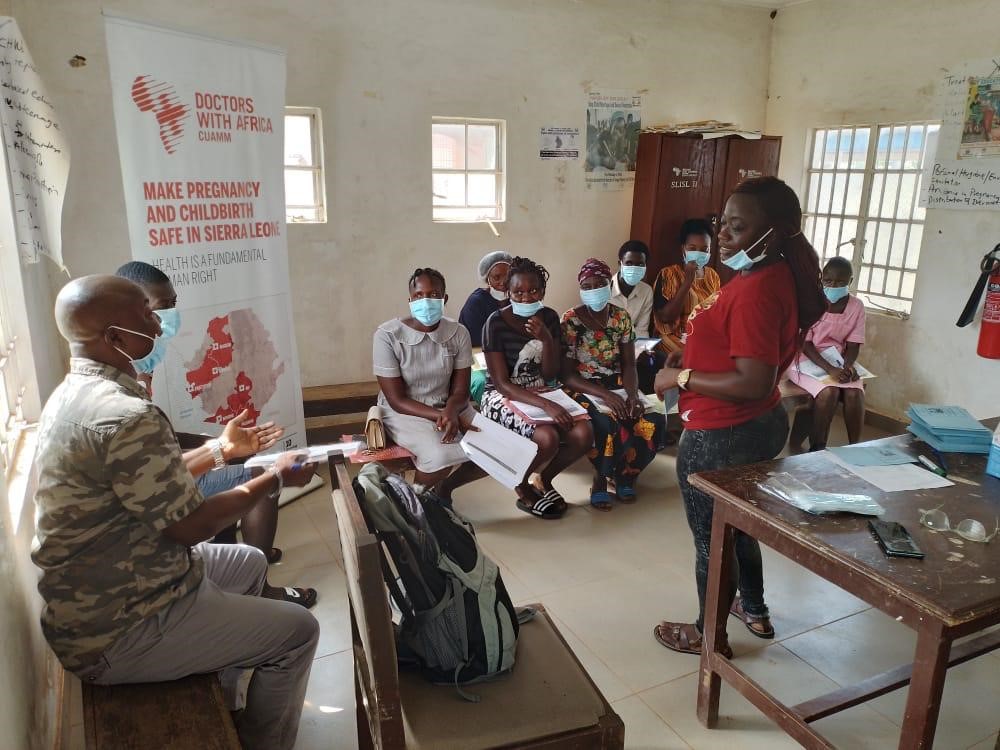
In Sierra Leon’s Pujehun District, connections between the community and health facilities are often difficult because of the very poor condition of the roads. Furthermore, the district is divided by a major river and has a riverine area reachable only by with boats, which further hinders access.
In March 2020, when the first case of COVID- 19 was registered in the country, how to best protect the populations was the top concern for government officials. The arrival in March 2021 of the first shipment of COVID- 19 vaccinations was welcome news, but there was still a major concern about how to get it those living hard to reach such as Pujehun District.
Working in partnership with Doctors with Africa (DwA) CUAMM, an Italian healthcare focused non-governmental organization, and with the support of a number of other NGOS, such as Focus 1000 and IRC, not only did Pujehun District see an increase in vaccination numbers, it ended up being among one of the districts with the highest vaccination coverage in the country.
Pujehun District, located in the southern province of Sierra Leone, is one of the poorest and least developed of the country’s 16 districts. It has a population of 429,574 inhabitants largely from the Mende ethnic group. The district lies about 50 miles south of Bo, and about 200 miles -south-east of the capital, Freetown from which it’s about five hours (321.6 km) by car via the Masiaka-Yonibana Highway. Diamond mining, in particular artisanal mining, is a major economic activity and the majority of its households, around 74 %, are engaged agriculture, mostly subsistence farming. Pujehun is a rural town and serves as the commercial and administrative center of Pujehun District.
In August 2021, in an effort to increase COVID-19 vaccination numbers among those age 18 years of age and older who were eligible to receive it, health authorities and the National COVID-19 Emergency Response Centre launched a massive “10 Days Surge” vaccination campaign. They deployed approximately 600 mobile and static teams of frontline personnel – health workers, community mobilizers, and data clerks – to administer the vaccines in towns and villages throughout the country.
In an effort to reach get as many people vaccinated as possible the government worked in partnership with a number of NGOS with CUAMM as the lead. Dr. Adrien Mbiya, head of CUAMM said the organization decided to support the government District Medical Health Team due to the low numbers of vaccinated people owing to the fact that were as there were lots of myths and misconception about the COVID-19 vaccines.
Doctors with Africa (DwA) CUAMM is an Italian non-governmental organization (NGO) working in Sierra Leone since 2012. It is present in the Pujehun district primarily focusing on maternal and child health care at the hospital and community level. The primary care network included 77 Ministry of Health Peripheral Health Units (PHUs), five of which provide basic emergency obstetrics care. The secondary care system consists of the public district hospital, which includes the Maternal and Child Health (MCH) complex, which provides comprehensive emergency obstetric and newborn care services.
Dr. Mbiya, noted that Pujehun District is surrounded by riverine communities which has difficult terrains especially during the raining season. He explained that it is very difficult to reach the farthest communities as there are some places vehicles cannot go except with motorbikes.
At the start of the surge in 2021, CUAMM donated motor bikes, cold boxes for vaccines, provided logistics support and pay the DSA (daily subsistence allowance) of the Vaccinators and Social Mobilisers who sensitize people living in the far end of the district.
As part of an unusual experiment to increase the uptake of the vaccine, CUAMM supported the surge by giving recipients a take-away food package after vaccination. His organisation employed the food-for-vaccine method, taking into consideration the poverty level in the district as most of them complained of not taking the vaccines due to lack of food.
The surge activity was a success. At the end of the surge, 133,119 inhabitants were fully vaccinated in Pujehun district from a target population of 273,822 which accounts for 32.1 percent of the target population. A key reason for that success was NGO partner assistance, in particular the efforts of CUAMM, health officials noted.
Data showed that Pujehun District ranked among the best performing districts in terms of coverage for target population fully vaccinated along with the districts of Kailahun and Kenema. Of the target population of around 273, 822, and 70.5% has been fully vaccinated and of the overall population around nearly half, 46.5 has been fully vaccinated, numbers that were achievable with the support of CUAMM and other NGO partners such as FOCUS 1000 and IRC.
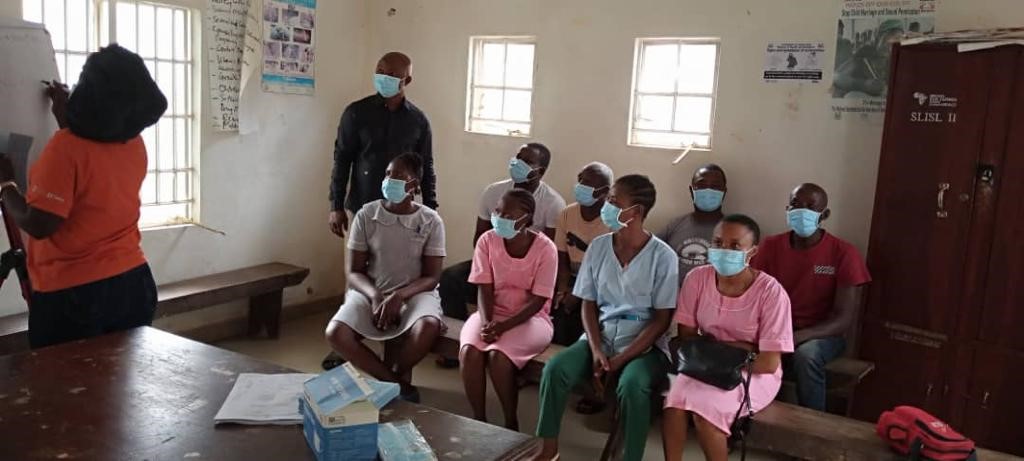
Nearly a year following that intensive campaign, in July 2022, aside the capital city, Pujehun District was still going strong in terms of getting its residents fully vaccinated even though CUAMM stopped the food-for-vaccine effort at the end of the 10 days surge in 2021.
Also, it’s notable that even though the government- funded vaccination drive is currently not ongoing in the district, CUAMM is utilising the District Health Management Team (DHMT) staff to rollout mobile vaccination teams across the district’s 14 Chiefdoms.
According to Dr. Mbiya, they have as many as eight teams at a time moving around two different Chiefdoms with a daily target of 200 doses to be administered. “In the district these days there is no surge organised by the government or any other NGO except us, we will continue with our support to the district,” he said.
At the start of the surge District Health Management Team Officer said Mohamed Jalloh, said they had three teams, a static team, a mobile team, and another team at Zimmi Makpele Chiefdom, which borders with Liberia. He said the support from CUAMM played a key role in making the 2021 surge a success, noting that the organization supported them with their Mobile Chiefdom Vaccination program and that this is on-going.
“We were committed, as the entire surge was devoid of politics as this is a health issue which do not care which party one belongs to. We did community engagement through radio and dialogued with religious and traditional elders” he said.
He added that initially getting people to agree to be vaccinated was not easy. The health teams faced a number of challenges including stiff resistance in some areas such as in Sorogbeima Chiefdom, Constituency 101, which was only resolved with the help of the Member of Parliament in that Constituency.
He also noted that the vaccination campaign also received support from a number of other NGOs working in the country, namely, FOCUS1000 and International Rescue Committee (IRC). Currently, the DHMT is only providing manpower, vaccines, screening forms and registers to CUAMM for the continuation of the campaign.
He also noted that the district’s geographic location and difficult accessibility also affected the type of vaccine that proved to be most popular. Four types of vaccines are being administered in the district: Sinopharm, AstraZeneca, Pfizer and Johnson & Johnson. Jalloh said for difficult terrains such as communities within Pujehun District, Johnson &Johnson is the most preferable for many because it is a single dose. The team mostly use Johnson & Johnson during their outreach in remote communities, he said.
Location wasn’t the only challenge the health team faced. For many, reaching the hearts and minds of the population was difficult because not everyone was easily convinced.
Master Farmer Mariama Rogers said she was afraid about the rumours behind the COVID-19 vaccine safety that is why it took her so long to only be vaccinated in 2022. “I am safe and sound now. I am an advocate for others to get vaccinated. My entire family is fully vaccinated” she said.
Imam Alhaji Abdulai J. Kamara who serves as the Public Relations Officer (PRO) for the Inter Religious Council, Pujehun District, said he and his household were the first to be vaccinated after the rollout with the healthcare workers as he trusted in the medical information they received from the experts.
As an Imam, the challenges at the start were enormous to convince their congregation not to heed to the misleading messages that were being shared on social media, he added. “Those messages created so much confusion amongst people in the district, we had to develop a syndicated sermon that was distributed to all the churches and mosques, including the hard to reach areas” he explained.
However, he said, for many, the not distant memory of the tragedies of the Ebola crisis helped move many people to overcome their fears.
Kamara said they never wanted the high mortality rate during the Ebola crisis to be repeated during the COVID-19 pandemic. “The lesson learned during the Ebola period gave us the zeal to join the campaign at an early stage to avoid mortality” he said.
JIJ/wr